How a department helps students learn the “hidden curriculum”
There is so much college students have to learn about college itself: Why bother going to office hours? What are the keys to time management? How can you explore future careers?
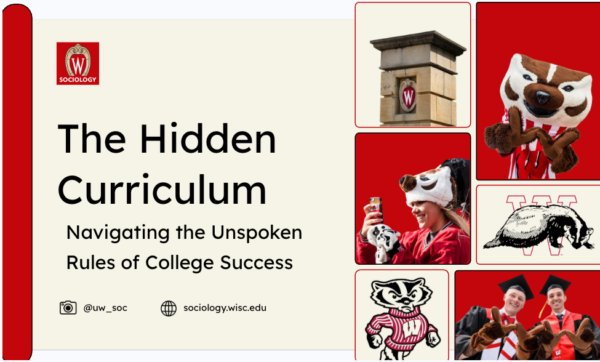
These are just a few of the questions tackled by Wendy Lee and Lyn Macgregor in a project for the Department of Sociology. Encouraged by Chair Eric Grodsky, they set out to explain the “hidden curriculum” – the expectations and good practices that are important to student success but aren’t always clearly communicated. Creating transparency can level the playing field and help all students reach their potential.
“We did some brainstorming about the kinds of topics we might cover and consulted some colleagues (including Jess Calarco who literally wrote the book on the navigating the hidden curriculum at the graduate level),” says Macgregor, the department’s director of undergraduate studies.
She and Lee, a graduate student, selected 14 topics and created short slide decks for each. Each deck cites research on the topic – for example, students who utilize academic support services achieve higher GPAs and are more likely to persist and graduate – and a step students can take, such as connecting with the Greater University Tutoring Service (GUTS).
“It turns out that instructors have mostly not adopted these exactly as they are. A couple have used the content but made the slides consistent with the aesthetics of their own presentations,” Macgregor says. “Some have just found in them reminders of points they want to cover early in the semester (e.g. the importance of office hours).”
“I’m really grateful to Lyn and Wendy for taking this on. As a sociologist of education, I have studied inequities in higher education for decades. It’s gratifying to be a small part of a real effort to reduce them,” Grodsky says. “Wisconsin has very high retention and graduation rates, but first-generation students continue to lag the campus average in persistence to the second year (two percentage points) and in six-year graduation (five percentage points).”
Other instructors and departments are welcome to use or adapt these slides, or create their own.
“I think other disciplines/departments could cover anything that they feel would increase student success such as discipline-specific learning resources, or ways students can identify credible discipline-specific sources of information and where to look for them,” Macgregor says. “I’ve also thought about whether decks like these could help demystify other features of the university as a whole: What is a research grant? What does it mean that an article is peer reviewed? What does my professor do all day when she’s not teaching? The goal here would be students understanding what universities are all about, how undergraduate education fits into them, and being better able to leverage that knowledge to enrich their experience here.”
Want to learn more?
Hear Lyn Macgregor discuss the hidden curriculum with the L&S Exchange, a podcast produced by the L&S Instructional Design Collaborative.